
- 0
- 1,290 word
When the average observer imagines a space launch, the mental image is dominated by the thunderous roar of the Saturn V, the blinding brilliance of F-1 engines, and the shedding of massive stages as the rocket pierces the atmosphere. We have been conditioned to view stage separation as a violent, gravity-assisted event: explosive bolts fire, metal groans, and the spent propellant tank falls away, pulled by the relentless tug of Earth’s gravity.
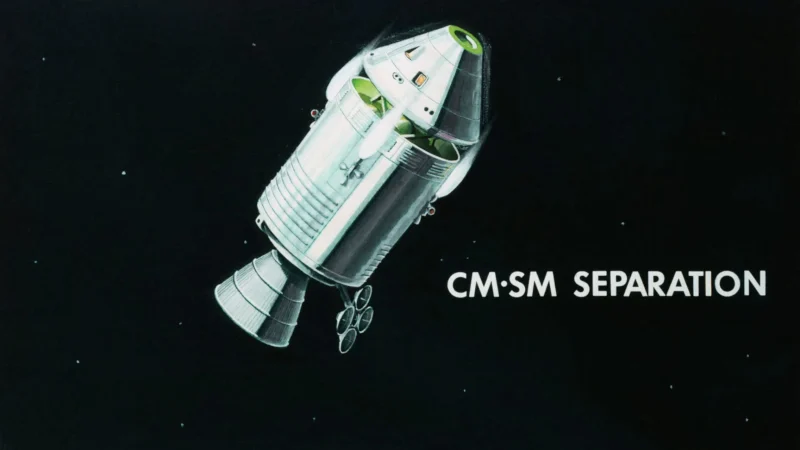
However, the most perilous moment of an Apollo mission was not the ascent, but the return. Before the Command Module (CM) could endure the searing heat of atmospheric reentry, it had to perform a delicate, high-stakes maneuver: the jettisoning of the Service Module (SM). This procedure, often overlooked in the grand narrative of the moon landings, was a masterclass in aerospace engineering, precision, and risk management.
The Engineering Challenge: Why Separation Was a Life-or-Death Hurdle
To understand the complexity of this maneuver, one must first understand the dependency the astronauts had on the Service Module. The SM was the lifeblood of the Apollo spacecraft. It housed the oxygen supply, the primary electrical fuel cells, the reaction control system (RCS) thrusters, and the critical Service Propulsion System (SPS) engine—the only engine capable of putting the crew on a trajectory back to Earth.
The Command Module, by contrast, was a cramped, minimalist cone designed solely for survival during the final plunge through the atmosphere and the subsequent splashdown. Once the SM was jettisoned, the CM had no power, no oxygen supply, and no propulsion. It was essentially a ballistic projectile. If the separation went wrong—if the SM bumped the CM, damaged the heat shield, or failed to clear the flight path—the mission would conclude in catastrophe.
The Physics of Orbit
In the vacuum of space, "letting go" is not as simple as opening a latch. Unlike an atmospheric launch where gravity reliably pulls a discarded stage away, orbital separation occurs in a state of freefall. Without a precise push, the SM would remain in close proximity to the CM, creating a collision hazard during the chaotic plasma environment of reentry.
A Chronology of the Separation Sequence
The separation of the Apollo Service Module was a meticulously choreographed sequence, requiring split-second timing and reliance on redundant systems.
1. Preparation and System Handover
Hours before reentry, the crew would conduct a "power down" of the Service Module. This involved transferring all electrical load to the Command Module’s internal batteries and ensuring the Environmental Control System (ECS) was configured for independent operation. The crew would then physically disconnect the "umbilicals"—the thick bundles of wiring and plumbing that fed electricity and life-support gases between the modules.
2. The Attitude Maneuver
The spacecraft was oriented to a specific "separation attitude." Mission Control dictated this orientation to ensure that the thrusters on the SM would not inadvertently push the CM into a dangerous reentry angle or leave it tumbling. The orientation had to be perfect to ensure the pyrotechnic charges fired simultaneously.
3. The Pyrotechnic Initiation
Separation was achieved via a series of explosive bolts and guillotines. When the command was sent, pyrotechnic charges would sever the structural connections between the modules. Simultaneously, the SM’s reaction control thrusters would fire in a sequence designed to push the SM away from the CM’s trajectory.
4. The Final Drift
Once the connection was severed, the CM and SM would drift apart. The crew would use the CM’s own small RCS thrusters to perform a final "separation burn," ensuring enough distance was created so that the heat generated by the SM’s eventual disintegration in the atmosphere would not pose a thermal threat to the CM.
Supporting Data: The Mechanics of Safety
The Apollo Service Module was a massive piece of hardware, weighing roughly 55,000 pounds when fully fueled. The Command Module was a mere 12,000 pounds. The inertia involved in this separation was significant.
Engineers at North American Rockwell spent years conducting computer simulations and wind-tunnel tests to determine the optimal "separation delta-v" (the change in velocity required to safely part ways). If the separation velocity was too low, the modules risked re-contact. If it was too high, the RCS fuel reserves—meant for steering the CM during the atmospheric descent—would be prematurely depleted.
The Thermal Protection System (TPS) Constraint
The most critical factor in this entire process was the integrity of the CM’s heat shield. The shield was an ablative material designed to burn away at temperatures exceeding 5,000 degrees Fahrenheit. Any physical contact with the SM during separation—even a minor scrape from a piece of metallic debris or a severed cable—could compromise the heat shield’s structural integrity. This is why the jettison process was essentially a "clean break" requirement; there was no room for error.
Official Perspectives and Historical Context
NASA’s archival documentation, including the Apollo 11 Mission Report, highlights the separation as a "critical mission event." The engineers involved noted that while the public focused on the Lunar Module (LEM) docking, the "re-entry prep" phase was where the highest level of system-wide integration was required.
"The separation was a ‘fire and forget’ event," noted a lead flight controller in post-mission debriefings. "We had to be absolutely certain that the SM was gone before we hit the ‘Entry Interface’ (EI) at 400,000 feet. If the SM was still there, the heat shield would have been compromised by the SM’s own debris, and the vehicle would have been lost."
Furthermore, the integration of "spy technology"—sensors and optical tracking systems developed for the National Reconnaissance Office (NRO)—allowed ground teams to monitor the structural separation with unprecedented fidelity. These sensors confirmed that the pyrotechnic bolts fired within milliseconds of each other, preventing the "yaw" or "pitch" motions that could have sent the SM tumbling into the CM.
Implications for Modern Aerospace
The lessons learned from the Apollo separation sequence remain foundational for modern space exploration. When SpaceX’s Dragon or Boeing’s Starliner prepare for reentry, they utilize variations of the Apollo separation logic.
Automation vs. Human Control
Apollo required manual input from the Command Module Pilot (CMP). Today, these systems are largely automated, yet the core philosophy remains the same: isolate the life-support module, clear the path, and ensure the heat shield is unobstructed. The Apollo program proved that human intervention in these final seconds could be a safety feature rather than a liability, provided the crew had adequate telemetry.
The Legacy of the "Tiny" Command Module
The success of the Apollo separation solidified the modular design philosophy. By isolating the reentry vehicle from the propellant and logistics module, NASA established a template that remains the standard for deep-space return missions. The ability to jettison the "heavy lifting" hardware and return only the "survival pod" to Earth is the reason we were able to bring crews back from the Moon with such high reliability.
Conclusion: A Silent Triumph
The separation of the Service Module was not a moment of high-octane drama like the liftoff, nor a moment of historic triumph like the lunar walk. It was a quiet, precise, and terrifyingly necessary act of engineering. It represented the moment the astronauts truly cut the cord with their home in space, accepting the gravity of Earth as their only guide for the final journey home.
Without the successful separation of the Service Module, the Apollo missions would have ended not in the Pacific Ocean, but in a streak of light across the sky. Understanding this complex maneuver reminds us that the history of space flight is not just about the roar of the engines, but about the silent, calculated decisions made in the cold vacuum of space, where the difference between success and catastrophe is measured in milliseconds and millimeters.
Author

Related Posts
Toshiba Unveils High-Performance Multiplexers to Power Next-Generation PCIe 6.0 and USB4 v2 Architectures
- 0
- 1,135 word
In the rapidly evolving landscape of high-speed data interconnects, the bottleneck often lies not in the processor or the memory, but in...
Read out all
MRAM Reaches a Strategic Tipping Point: New Industry Alliance Formed to Scale Adoption
- 0
- 1,114 word
Magnetoresistive Random Access Memory (MRAM)—a technology once relegated to the fringe of semiconductor research—has officially hit a commercial and technical tipping point....
Read out all
DEEPX Unveils the DX-AIPlayer: Bridging the Gap Between Edge Computing and High-Performance AI
- 0
- 1,258 word
In the rapidly evolving landscape of edge artificial intelligence, the demand for hardware that balances power efficiency with high-throughput inference has never...
Read out all
The Smart Shopper’s Pulse: Tracking the Best Daily Deals in an Era of Digital Hype
- 0
- 1,214 word
By Daniel Oropeza | Shopping Editor May 13, 2026 In the modern digital marketplace, the consumer is bombarded with a relentless stream...
Read out all
Bridging the Digital Divide: How Experience AI is Empowering Classrooms in Uzbekistan
- 0
- 1,266 word
In an era defined by the rapid proliferation of artificial intelligence, the global race to ensure digital equity has moved beyond basic...
Read out all
The Mirror in the Machine: Unmasking Algorithmic Bias in the Age of AI
- 0
- 1,266 word
The widespread adoption of artificial intelligence (AI) has been accompanied by a persistent, often unexamined, myth: that algorithms are objective, mathematically neutral...
Read out all