

- 0
- 1,266 word
In an era defined by the rapid proliferation of artificial intelligence, the global race to ensure digital equity has moved beyond basic computer literacy. Today, the focus has shifted toward AI literacy—the ability to not only use, but critically evaluate, the algorithms that increasingly shape our world. At the forefront of this movement is Experience AI, a global initiative designed to demystify machine learning for students and educators.
In a significant expansion of its reach, Experience AI has officially entered Uzbekistan through a strategic partnership with UNICEF. This collaboration integrates cutting-edge AI education into the existing "Tinkering with Tech" programme, a multi-faceted effort aimed at equipping the next generation of Uzbekistani learners with the 21st-century skills necessary to thrive in an automated future.
The Mandate: Why AI Literacy Matters Now
The integration of AI into school curricula is no longer an optional luxury; it is a fundamental requirement for workforce participation. As AI systems become embedded in logistics, healthcare, agriculture, and public services, the gap between those who understand these systems and those who are merely subject to them is widening.
The Experience AI initiative, backed by the Raspberry Pi Foundation and supported by partners including Arm and the Micro:bit Educational Foundation, seeks to bridge this gap. By focusing on computational thinking and critical analysis, the programme empowers educators to move past the "magic" of AI and into the mechanics of how it functions, where it fails, and why bias is an inherent challenge in algorithmic development.
A Journey to Tashkent: The Chronology of Implementation
The implementation of this initiative in Uzbekistan was a carefully orchestrated process, rooted in on-the-ground engagement.
Pre-Departure Inquiries
As one of the Learning Managers on the Foundation’s AI literacy team, my journey to Tashkent began with a series of fundamental questions regarding the local digital landscape. I questioned the readiness of the educators: Would they be intimidated by the pace of AI advancement? Was there a tangible interest in the subject matter, or would I be met with skepticism? These concerns were rooted in the awareness that AI is often presented as a Western-centric, high-tech phenomenon that may feel disconnected from the daily realities of classrooms in Central Asia.
The Training Sessions: A Rapid Response
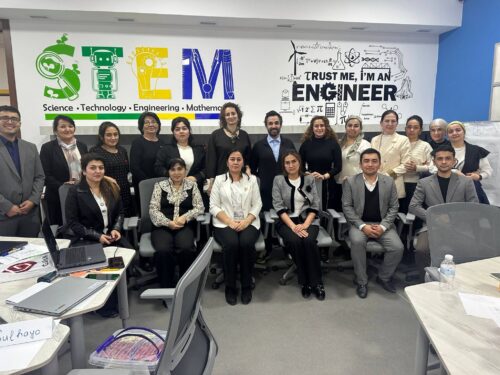
Upon arriving in Tashkent, these concerns were immediately addressed. The training sessions brought together a diverse group of educators—teachers, curriculum designers, and digital trainers—who had traveled from both the bustling urban centers and the more remote, rural provinces of Uzbekistan.
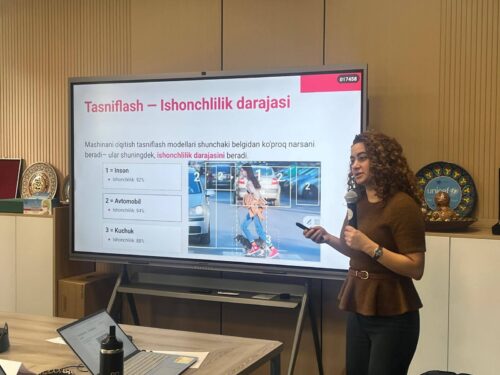
The engagement level was immediate. Within minutes of the inaugural session, it was clear that these educators were not passive observers; they were active users of AI who were already experimenting with generative tools in their personal lives. The training provided a structured environment to transition from being casual users to critical thinkers. We focused on technical pillars—such as classification, data accuracy, and model training—while simultaneously holding space for the ethical dilemmas that define modern AI.
Supporting Data and Real-World Evidence
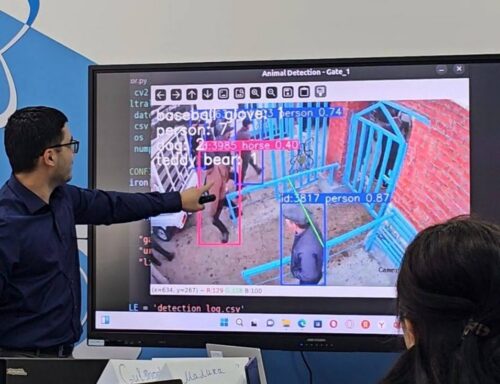
To move from theory to practice, the training relied on localized examples, which proved to be the most effective teaching tool. One particularly poignant example was shared by a local trainer who presented video footage from a cattle market.
In this footage, an AI-powered surveillance system, designed for traffic and livestock monitoring, was seen misclassifying subjects: a human was identified as a horse, and a goat was labeled as a human. While the room erupted in laughter, the incident served as a critical educational pivot point. We used this "harmless" error to transition into a high-stakes discussion:
- The "Black Box" Problem: If an AI can misclassify a goat in a controlled environment, what are the implications when the stakes are higher?
- Safety and Reliability: We examined the safety thresholds of autonomous vehicles, discussing how an AI might struggle to differentiate between a child in a high-visibility coat and a stationary object.
- Algorithmic Accountability: The discussion shifted from the error itself to the data used to train the model, highlighting how the quality of input dictates the safety of the output.
Localisation: The Power of Contextual Representation
Perhaps the most powerful exercise in the programme involved the use of generative AI to visualize local landmarks. We asked participants to generate an image of Gulistan, a city in eastern Uzbekistan.
The results were jarring and educational. The AI, drawing on a global dataset that often skews toward Western visual tropes, rendered Gulistan with snow-capped mountains and European-style cathedrals—a stark departure from the city’s actual flat, arid landscape and its rich history of mosques.
This sparked a profound realization among the attendees. The lack of cultural neutrality in AI tools is not just a technical flaw; it is a form of digital erasure. The trainers began to grapple with the reality that if their students rely on these models for information, they are consuming a skewed, Westernized version of their own identity. As one educator noted, "I have changed my mind about AI; I now see that it is not a neutral arbiter of truth, but a mirror reflecting the biases of its training data."
Official Perspectives: The UNICEF-Tinkering with Tech Partnership
The "Tinkering with Tech and AI" initiative, supported by the Government of Finland and strategic partners like Arm, is designed to be a scalable model for global education.
"Our goal is not just to teach coding, but to foster a generation of creators and critical thinkers who can shape the AI landscape rather than be shaped by it," says a spokesperson for the initiative. The collaboration focuses on sustainability. By training the trainers, the programme ensures that the knowledge remains within the Uzbekistani educational ecosystem, allowing local experts to adapt the curriculum to the specific linguistic and cultural needs of their students.
Implications for Global Education
The lessons learned in Uzbekistan have broad implications for how we view the "global classroom."

Addressing Disparities
Classrooms are not uniform. While some schools in Uzbekistan enjoy high-speed internet and interactive whiteboards, others face significant constraints, including unstable electricity and a reliance on shared devices. The Experience AI methodology is intentionally designed to be flexible. By emphasizing the logic of AI—how it learns from data—rather than just the software interfaces, the curriculum remains relevant even in low-resource environments.
The Future of AI Literacy
The success of this pilot program demonstrates that AI literacy is universal. Whether in South Africa, Saudi Arabia, or Uzbekistan, the core challenges remain the same:
- Demystification: Removing the "black box" aura that surrounds AI.
- Critical Engagement: Challenging the assumption that AI is always accurate.
- Representation: Ensuring that local cultures and languages are accounted for in the development of future models.
Conclusion: Shaping the Future
The journey to Uzbekistan has reinforced a core tenet of the Experience AI philosophy: that the most effective way to prepare for the future is to understand the present. By integrating these critical skills into the Tinkering with Tech programme, we are not just teaching students how to use a tool; we are teaching them how to interrogate the systems that will govern their future.
As we continue to scale this initiative, the feedback from Uzbekistani educators serves as a blueprint. It confirms that when teachers are equipped with the right conceptual tools, they become the most effective advocates for responsible AI. Together, we are ensuring that the next generation of thinkers, regardless of where they are in the world, possesses the agency to ensure that technology serves humanity, rather than the other way around.

For further information on how to bring these resources to your school, please visit experience-ai.org.
Author

Related Posts

Toshiba Unveils High-Performance Multiplexers to Power Next-Generation PCIe 6.0 and USB4 v2 Architectures
- 0
- 1,135 word
In the rapidly evolving landscape of high-speed data interconnects, the bottleneck often lies not in the processor or the memory, but in...
Read out all
MRAM Reaches a Strategic Tipping Point: New Industry Alliance Formed to Scale Adoption
- 0
- 1,114 word
Magnetoresistive Random Access Memory (MRAM)—a technology once relegated to the fringe of semiconductor research—has officially hit a commercial and technical tipping point....
Read out all
DEEPX Unveils the DX-AIPlayer: Bridging the Gap Between Edge Computing and High-Performance AI
- 0
- 1,258 word
In the rapidly evolving landscape of edge artificial intelligence, the demand for hardware that balances power efficiency with high-throughput inference has never...
Read out all
The Smart Shopper’s Pulse: Tracking the Best Daily Deals in an Era of Digital Hype
- 0
- 1,214 word
By Daniel Oropeza | Shopping Editor May 13, 2026 In the modern digital marketplace, the consumer is bombarded with a relentless stream...
Read out all
The Mirror in the Machine: Unmasking Algorithmic Bias in the Age of AI
- 0
- 1,266 word
The widespread adoption of artificial intelligence (AI) has been accompanied by a persistent, often unexamined, myth: that algorithms are objective, mathematically neutral...
Read out all
Coding for the Future: Young Innovators Shine at Coolest Projects USA Minnesota
- 0
- 1,396 word
The Science Museum of Minnesota transformed into a vibrant hub of innovation on April 11, as it played host to the second...
Read out all