

- 0
- 1,213 word
The Mary Rose, the flagship of King Henry VIII’s formidable Tudor navy, remains one of the most significant archaeological treasures in maritime history. Sunk during the Battle of the Solent in 1545 while engaging a French invasion fleet, the ship’s preservation in the silt of the Solent seabed has provided historians with an unparalleled snapshot of 16th-century naval warfare. Among the thousands of artifacts recovered since the ship was raised in 1982, none are as enigmatic—or as terrifying—as the massive, iron-tipped darts found deep within the hull.
Recent experimental archaeology conducted by Tod’s Workshop has finally shed light on these mysterious projectiles. By meticulously reconstructing these "fire darts," researchers are beginning to understand how Henry VIII’s sailors intended to turn the tides of battle into a literal inferno.
The Chronology of Discovery: From Seabed to Laboratory
The story of the Mary Rose incendiary darts begins not with their use, but with their rediscovery. Following the ship’s location in 1971 and its historic salvage operation in 1982, the hull was subjected to decades of conservation. As curators and archaeologists painstakingly cataloged the ship’s armory, they encountered a series of iron-headed darts that defied conventional classification.
A Timeline of the Mystery:
- 1545: The Mary Rose founders in the Solent. The incendiary darts remain sealed in an anaerobic environment for over four centuries.
- 1971: Divers locate the wreck, sparking a global interest in maritime archaeology.
- 1982: The hull is raised, revealing the internal contents of the ship, including the mysterious darts stored near the upper decks.
- 2020–2025: Advanced analysis of the dart remnants reveals traces of pitch, cloth, and specialized wooden fuses, suggesting an incendiary function.
- 2026: Tod’s Workshop releases a comprehensive experimental study, testing the feasibility of these projectiles in real-world scenarios.
The darts were found in proximity to a specific cannon—a piece of artillery that was notably miscast and angled at an upward trajectory. This placement fueled intense speculation: were these darts merely hand-thrown weapons for sailors in the rigging, or were they the ammunition for an experimental, ship-to-ship incendiary system?
Anatomy of an Incendiary Weapon
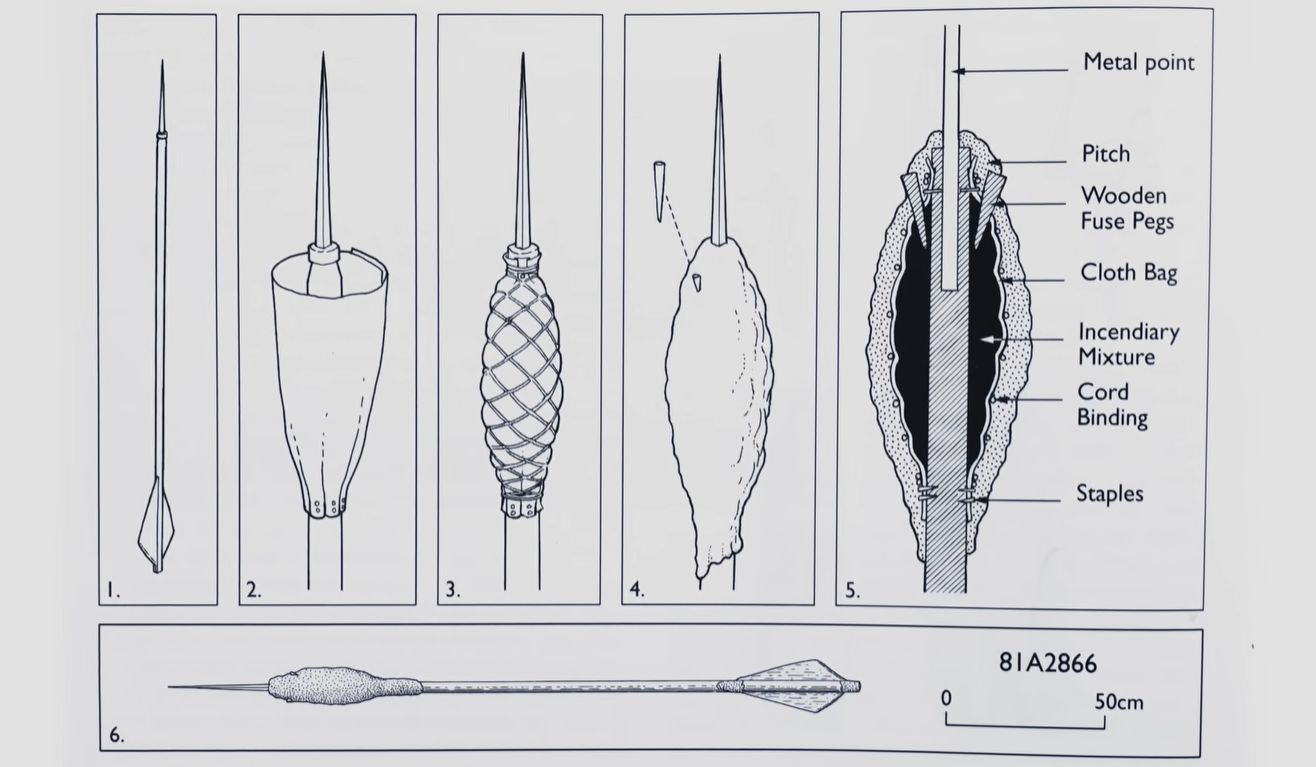
To understand the lethality of these darts, one must look at their construction. Based on the archaeological remnants, the reproduction darts featured a weighted iron head designed to penetrate the oak hulls of contemporary vessels. Behind the head lay a payload container, wrapped in heavy, pitch-coated cloth.
The mechanism was surprisingly sophisticated. A wooden fuse, calculated to burn for a specific duration, acted as the timer. Once the dart struck its target, the burning fuse would ignite the incendiary mixture, creating a localized fire that would be nearly impossible to extinguish under the stress of combat. Unlike a standard fire arrow, which relied on open flames that could be blown out by wind or extinguished upon impact, these darts were designed to lodge deep within the ship’s timber, turning the enemy’s own structure into fuel.
The Mechanics of Launch: Hand-Thrown vs. Artillery
The central debate surrounding the Mary Rose darts has always been the method of deployment. The weight and design of the projectiles suggest a high-impact requirement, which is difficult to achieve by hand-throwing alone.
The "Crow’s Nest" Theory
One school of thought suggests that the darts were intended for sailors stationed in the ship’s fighting tops. Dropping these incendiaries from height would certainly provide the velocity needed to embed them in a deck, but the accuracy would be poor, and the risk of the fire blowing back onto one’s own ship was extreme.
The Artillery Hypothesis
The proximity of the darts to a miscast, upward-angled cannon suggests a more radical theory. Could the Tudors have been experimenting with primitive "fire cannons"? The Tod’s Workshop team utilized a compressed-air cannon to simulate the firing of a full-scale projectile. The results were illuminating:
- High-Velocity Tests: A full-charge launch resulted in the complete structural disintegration of the dart. The force of the gunpowder explosion was simply too violent for the projectile’s delicate incendiary housing.
- Reduced-Charge Tests: Using a "soft" or reduced charge allowed the dart to maintain structural integrity while achieving a significant range.
The findings indicate that while these weapons were likely not meant to be fired with the full powder charges used for iron cannonballs, they could have been highly effective at short-to-medium range against enemy rigging or wooden decking.
Implications for Tudor Naval Warfare
The existence of these darts suggests that the English Navy was operating on the cutting edge of psychological and destructive warfare. If the Mary Rose had been outfitted with a battery of these projectiles, the tactical implications would have been profound.
- Psychological Dominance: Even if the darts didn’t immediately sink a ship, the threat of an unextinguishable fire spreading through a wooden vessel would have been a significant deterrent.
- Strategic Targeting: By focusing on the enemy’s sails and rigging, these darts could disable an enemy ship’s maneuverability, leaving it a sitting duck for the heavy cannon fire that defined the era.
- Experimental Failure: The presence of a miscast cannon near the darts may suggest that the project was a work in progress. It is possible that the English were attempting to bridge the gap between traditional archery and the nascent age of gunpowder artillery, and that these darts were the failed prototypes of a technology that never quite reached mass adoption.
Scholarly Perspectives and Official Responses
Maritime historians have greeted the Tod’s Workshop experiments with cautious optimism. While the tests provide a physical demonstration of the weapon’s potential, some researchers caution against assuming they were a standard issue.
"We have to be careful not to view these through the lens of modern precision engineering," notes a lead conservator from the Mary Rose Museum. "The Tudor navy was a hive of experimentation. These darts represent a period where the traditional ways of war—the longbow and the fire-pot—were colliding with the new, loud, and unpredictable reality of gunpowder. Whether these were an effective tool or a dangerous, experimental hazard is still a matter of rigorous debate."
The consensus among the academic community is that the darts likely represent a "transitional technology." They reflect a desperate need to gain a tactical advantage in the crowded, close-quarters naval engagements of the mid-16th century.
Conclusion: The Legacy of the Fire Darts
The Mary Rose remains a sentinel of a lost era. The discovery and subsequent testing of these incendiary darts serve as a reminder that history is not just a collection of dates and figures, but a record of human ingenuity in the face of conflict.
As we continue to analyze the artifacts recovered from the wreck, we gain a clearer picture of the technological ambition of King Henry VIII’s navy. Whether these darts were the terror of the seas or merely a dangerous experiment that never left the drawing board, they remain a testament to the fact that, in the 16th century, the battle for supremacy on the waves was fought with fire, steel, and a constant, burning drive to innovate.
For now, the Mary Rose continues to yield its secrets, and with each passing year, the silent, waterlogged hull tells us a little more about the men who fought—and burned—in the service of the Tudor crown.
Author

Related Posts

Toshiba Unveils High-Performance Multiplexers to Power Next-Generation PCIe 6.0 and USB4 v2 Architectures
- 0
- 1,135 word
In the rapidly evolving landscape of high-speed data interconnects, the bottleneck often lies not in the processor or the memory, but in...
Read out all
MRAM Reaches a Strategic Tipping Point: New Industry Alliance Formed to Scale Adoption
- 0
- 1,114 word
Magnetoresistive Random Access Memory (MRAM)—a technology once relegated to the fringe of semiconductor research—has officially hit a commercial and technical tipping point....
Read out all
DEEPX Unveils the DX-AIPlayer: Bridging the Gap Between Edge Computing and High-Performance AI
- 0
- 1,258 word
In the rapidly evolving landscape of edge artificial intelligence, the demand for hardware that balances power efficiency with high-throughput inference has never...
Read out all
The Smart Shopper’s Pulse: Tracking the Best Daily Deals in an Era of Digital Hype
- 0
- 1,214 word
By Daniel Oropeza | Shopping Editor May 13, 2026 In the modern digital marketplace, the consumer is bombarded with a relentless stream...
Read out all
Bridging the Digital Divide: How Experience AI is Empowering Classrooms in Uzbekistan
- 0
- 1,266 word
In an era defined by the rapid proliferation of artificial intelligence, the global race to ensure digital equity has moved beyond basic...
Read out all
The Mirror in the Machine: Unmasking Algorithmic Bias in the Age of AI
- 0
- 1,266 word
The widespread adoption of artificial intelligence (AI) has been accompanied by a persistent, often unexamined, myth: that algorithms are objective, mathematically neutral...
Read out all