
- 0
- 1,176 word
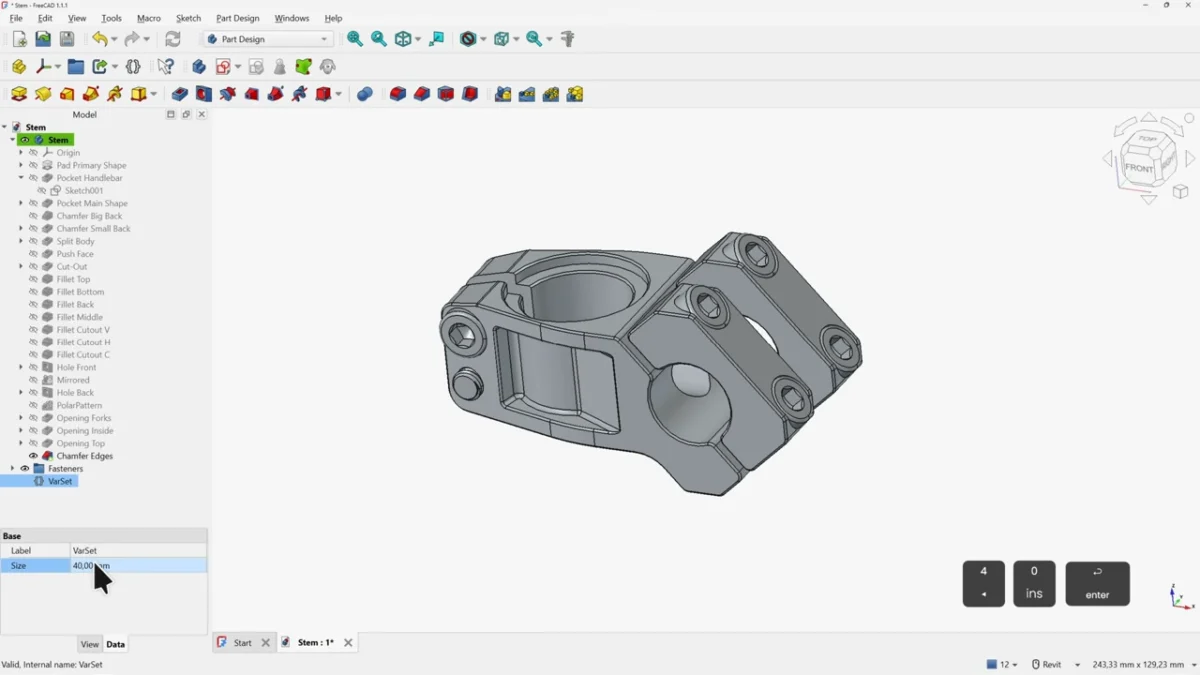
For engineers, makers, and open-source enthusiasts, the barrier to entry for professional-grade CAD (Computer-Aided Design) software has historically been defined by steep learning curves and prohibitive licensing costs. FreeCAD, the long-standing open-source parametric modeler, has long promised a solution to this, but its sprawling feature set often leaves newcomers overwhelmed. However, a new instructional resource from the creator [Deltahedra] has emerged as a definitive roadmap for those looking to master FreeCAD 1.1, focusing on the intersection of efficiency, best engineering practices, and intuitive design workflows.
Main Facts: The New Standard in CAD Education
The recent release of a comprehensive tutorial by [Deltahedra] marks a significant milestone for the FreeCAD community. By centering the curriculum on version 1.1—the latest stable release—this guide effectively eliminates the "version drift" that frequently plagues technical tutorials. Users often struggle when attempting to replicate decade-old workflows in modern software; by anchoring the lesson in the current UI and feature set, the tutorial provides a seamless experience for those installing the software for the first time.
The video serves as a masterclass in the "Part Design" workbench, which remains the primary toolset for most mechanical design tasks. Rather than attempting to cover every niche function of the software, the tutorial focuses on the fundamental goal: taking a 3D part from a concept to a finished model. This approach is deliberate. By narrowing the scope, [Deltahedra] ensures that the viewer understands the "why" behind the "how," emphasizing best practices that translate to professional engineering environments. The video even goes a step further by including an introduction to the interface, acknowledging that for many, the hurdle is not the design logic, but simply finding the correct buttons in an unfamiliar environment.
Chronology: The Evolution of FreeCAD Accessibility
The journey of FreeCAD from a niche hobbyist tool to a robust, enterprise-capable platform has been a multi-year effort.
- The Early Years: FreeCAD began as a community-driven project intended to provide a modular, parametric alternative to proprietary CAD packages. For years, development focused on core engine stability and kernel integration.
- The UI/UX Turning Point: As the community grew, the primary criticism leveled at FreeCAD was the lack of onboarding materials. While the software was powerful, the interface was often labeled "non-intuitive" by those transitioning from commercial software like SolidWorks or Autodesk Fusion 360.
- The 1.0/1.1 Transition: The release of 1.0, and subsequently 1.1, signaled a shift in the development team’s philosophy. There was a concerted effort to clean up the workbench ecosystem and solidify the user experience.
- The Current Moment: With the release of [Deltahedra]’s tutorial, the community has effectively bridged the final gap: the educational deficit. By pairing a stable, mature software release with high-quality, pedagogical content, the barrier to entry has arguably never been lower.
Supporting Data: Why "Best Practices" Matter
In the world of parametric modeling, the difference between a novice and a professional is not just the ability to create a shape, but the ability to create a robust shape. A part created without proper constraints or a logical design tree is a "fragile" model; a minor change to a single dimension could cause the entire assembly to fail or the geometry to collapse.
[Deltahedra] emphasizes the importance of:
- Logical Sketching: Building sketches that are fully constrained, preventing unintended movement of geometry.
- The Master Model Workflow: Establishing a clear hierarchy where features are built upon one another in a way that respects dependencies.
- Error Handling: A critical component of the tutorial is the inclusion of "common mistakes." By showing the viewer what happens when a sketch fails and how to systematically diagnose the error, the tutorial turns potential frustrations into teachable moments.
This methodology aligns with the principles championed by experienced practitioners in the field. For instance, Arya Voronova’s recent discourse on FreeCAD best practices echoes this sentiment, arguing that adopting rigorous design habits early prevents the "spaghetti model" effect, where designs become impossible to modify as they grow in complexity.
Official Responses and Community Reception
The response to this tutorial has been overwhelmingly positive, particularly among the core FreeCAD contributor base. In the open-source world, documentation is often the most neglected aspect of development. Therefore, when a high-quality, external resource appears, it is frequently embraced as an "official-adjacent" standard for new users.
Industry observers and power users have noted that the video serves as a crucial recruitment tool for the software. By demonstrating that FreeCAD 1.1 is not just "good for free," but a legitimate environment for professional-grade part design, the video validates the years of volunteer effort put into the software’s underlying kernel. The community’s gratitude—highlighted by the tip from [Vik Olliver]—demonstrates the collaborative spirit of the FreeCAD ecosystem, where knowledge is shared as freely as the code itself.
Implications: The Future of Open-Source Engineering
The implications of this shift are profound for both the software and the manufacturing industry.
Lowering the Barrier to Innovation
As proprietary software continues to move toward subscription-based models, many independent engineers and small startups are feeling the financial squeeze. FreeCAD 1.1, bolstered by high-quality tutorials, offers a permanent, offline-capable, and transparent alternative. When a user spends their time learning a tool, they are making an investment. By choosing FreeCAD, they are investing in an open standard that cannot be suddenly "sunsetted" or moved behind a paywall.
Standardizing Professional Workflow
There is a common misconception that "open source" implies "unprofessional." The workflow presented in the [Deltahedra] tutorial dismantles this. By adhering to standardized engineering practices—such as naming constraints, grouping operations, and maintaining clean, hierarchical design trees—users are learning skills that are directly transferable to any commercial CAD suite. The software is merely the vehicle; the engineering logic is the destination.
The Self-Directed Learning Model
The success of this tutorial highlights a broader trend in professional development: the rise of the self-directed engineer. With high-quality, niche-focused video content, individuals can now achieve a level of proficiency that previously required formal, expensive training courses. This democratizes engineering design, allowing a maker in a home garage to potentially develop parts with the same level of parametric rigor as an engineer in a multi-national firm.
Conclusion: A Call to Action
For those who have been "CAD-curious" but intimidated by the software’s reputation, the arrival of this tutorial is the ideal invitation to start. The path forward is no longer defined by trial and error, but by a structured, logical progression that respects the user’s time and intelligence.
FreeCAD 1.1 is not a perfect piece of software—no CAD program is—but it is an incredibly powerful, community-vetted, and stable platform that is now more accessible than ever. By following the best practices outlined by [Deltahedra] and building a solid foundation in the Part Design workbench, users can move beyond simple modeling and into the realm of complex, parametric engineering. Whether you are designing custom enclosures for electronics, mechanical components for robotics, or simply exploring the possibilities of additive manufacturing, the tools are now in your hands. It is time to open the software, follow the guide, and begin building the future, one sketch at a time.
Author

Related Posts
Toshiba Unveils High-Performance Multiplexers to Power Next-Generation PCIe 6.0 and USB4 v2 Architectures
- 0
- 1,135 word
In the rapidly evolving landscape of high-speed data interconnects, the bottleneck often lies not in the processor or the memory, but in...
Read out all
MRAM Reaches a Strategic Tipping Point: New Industry Alliance Formed to Scale Adoption
- 0
- 1,114 word
Magnetoresistive Random Access Memory (MRAM)—a technology once relegated to the fringe of semiconductor research—has officially hit a commercial and technical tipping point....
Read out all
DEEPX Unveils the DX-AIPlayer: Bridging the Gap Between Edge Computing and High-Performance AI
- 0
- 1,258 word
In the rapidly evolving landscape of edge artificial intelligence, the demand for hardware that balances power efficiency with high-throughput inference has never...
Read out all
The Smart Shopper’s Pulse: Tracking the Best Daily Deals in an Era of Digital Hype
- 0
- 1,214 word
By Daniel Oropeza | Shopping Editor May 13, 2026 In the modern digital marketplace, the consumer is bombarded with a relentless stream...
Read out all
Bridging the Digital Divide: How Experience AI is Empowering Classrooms in Uzbekistan
- 0
- 1,266 word
In an era defined by the rapid proliferation of artificial intelligence, the global race to ensure digital equity has moved beyond basic...
Read out all
The Mirror in the Machine: Unmasking Algorithmic Bias in the Age of AI
- 0
- 1,266 word
The widespread adoption of artificial intelligence (AI) has been accompanied by a persistent, often unexamined, myth: that algorithms are objective, mathematically neutral...
Read out all