
- 0
- 1,274 word
For the dedicated engineer or hobbyist, there is a singular, quiet satisfaction found in a perfectly constrained CAD sketch. It is the digital equivalent of a clean desk: every line defined, every dimension locked, and every warning icon banished. Yet, the path to that state of "inner peace" is often paved with tedious, repetitive labor—the kind of work that drains the creative spirit of even the most skilled professionals.
Enter Hestus, an emerging AI-powered tool designed to transform the CAD workflow. By acting as an intelligent co-pilot, Hestus aims to reduce the "busy work" of sketching, allowing engineers to focus on the high-level architecture of their designs.
The Origin Story: Born from Aerospace Necessity
The genesis of Hestus lies in the high-stakes environment of aerospace engineering. Founder Sohrab Haghighat, a veteran of the industry and former head of the space launch startup SpaceRyde, saw firsthand the friction between ambitious engineering goals and the sluggish reality of manual CAD drafting.
In a startup environment, time is the most volatile commodity. Competing against industry titans with near-infinite resources meant that every hour spent manually applying constraints or sketching construction lines was an hour stolen from mission-critical innovation. Haghighat realized that his best talent was being bogged down by the minutiae of model definition.
"We couldn’t afford to waste time on trivial tasks," Haghighat explained. "I wanted a tool that would speed up the workflow without getting in the way."
Recognizing that existing CAD software remained fundamentally tethered to manual input, he set out to build the solution he desperately needed during his time at SpaceRyde. The result is Hestus: a plugin that treats AI not as a generative replacement for the engineer, but as a silent, high-speed assistant that anticipates the next logical step in a design.
How It Works: The "Co-Pilot" Paradigm
Hestus operates on a philosophy of augmentation rather than automation. It is currently available as a plugin for Autodesk Fusion, with support for SolidWorks slated for a June release.
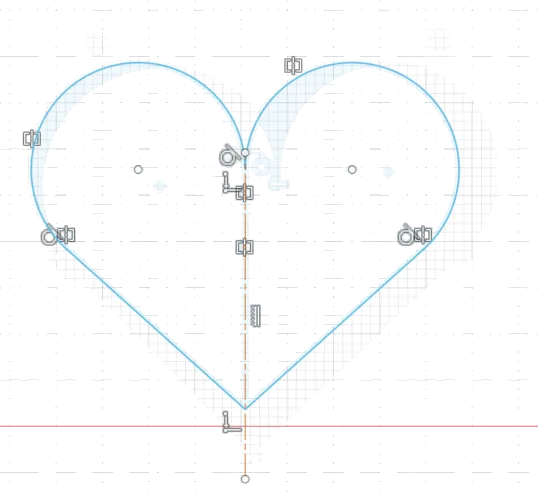
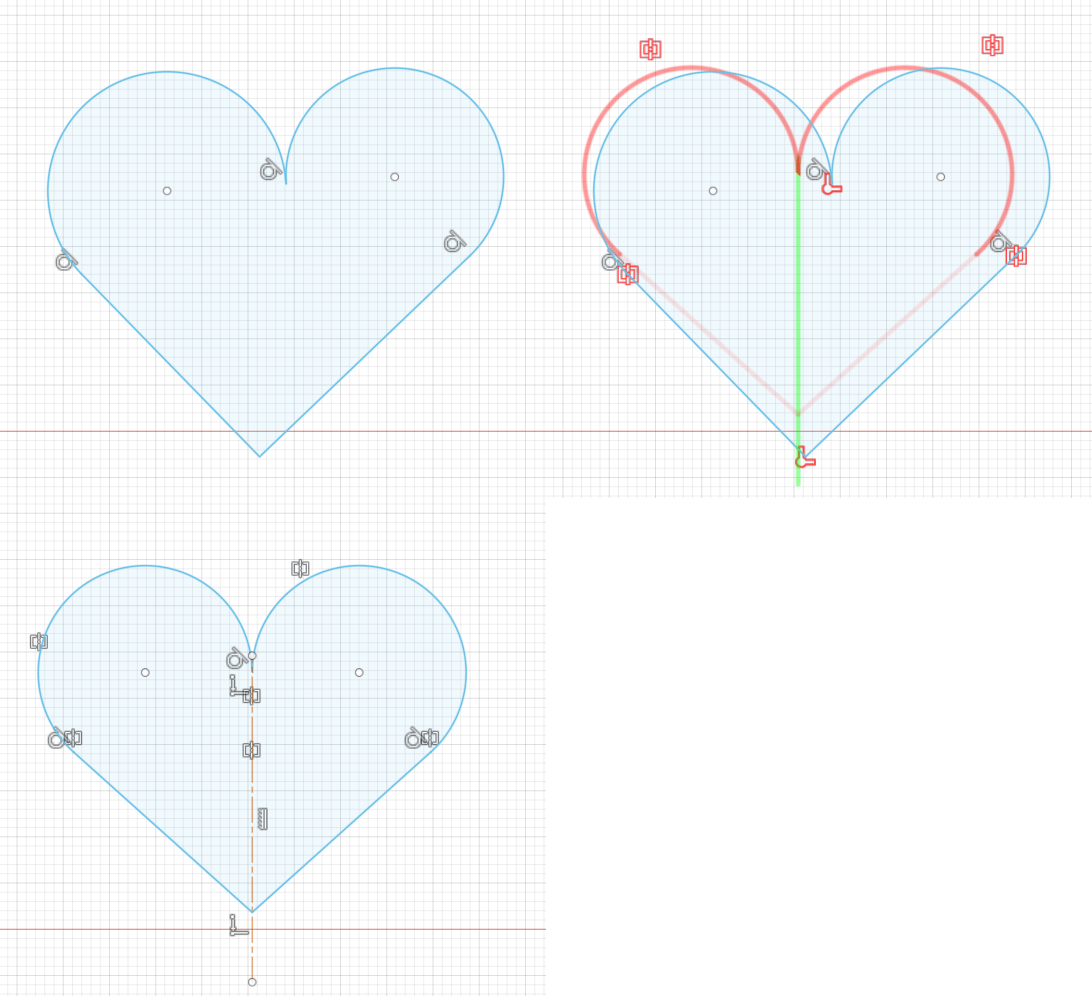
When a user begins a sketch, Hestus monitors the input in real-time. It then presents a non-intrusive window containing predictive suggestions. If a user draws a circle, for instance, Hestus might instantly suggest applying a horizontal or vertical constraint, or perhaps mirroring the geometry across an axis. The engineer retains total control: they can accept a suggestion via hotkeys, cycle through alternatives, or ignore the AI entirely if they prefer to work manually.

This "human-in-the-loop" design is intentional. In this paradigm, the AI does the heavy lifting for repetitive, rule-based tasks—such as ensuring symmetry or applying geometric constraints—while the human engineer remains the sole navigator of the design’s intent.
Putting Hestus to the Test: From Raspberry Pi Cases to Complex Geometry
To understand the practical impact of Hestus, we put the tool through a series of stress tests, ranging from simple consumer electronics enclosures to more complex geometric models.
Case Study: Iterative Enclosure Design
When modifying an existing Raspberry Pi case, the benefits of Hestus were immediate. The software’s ability to recognize symmetry in real-time meant that adding mounting holes or ventilation ports became a one-click process rather than a multi-step chore of drawing construction lines and applying dimensions.
Case Study: Geometric Patterning
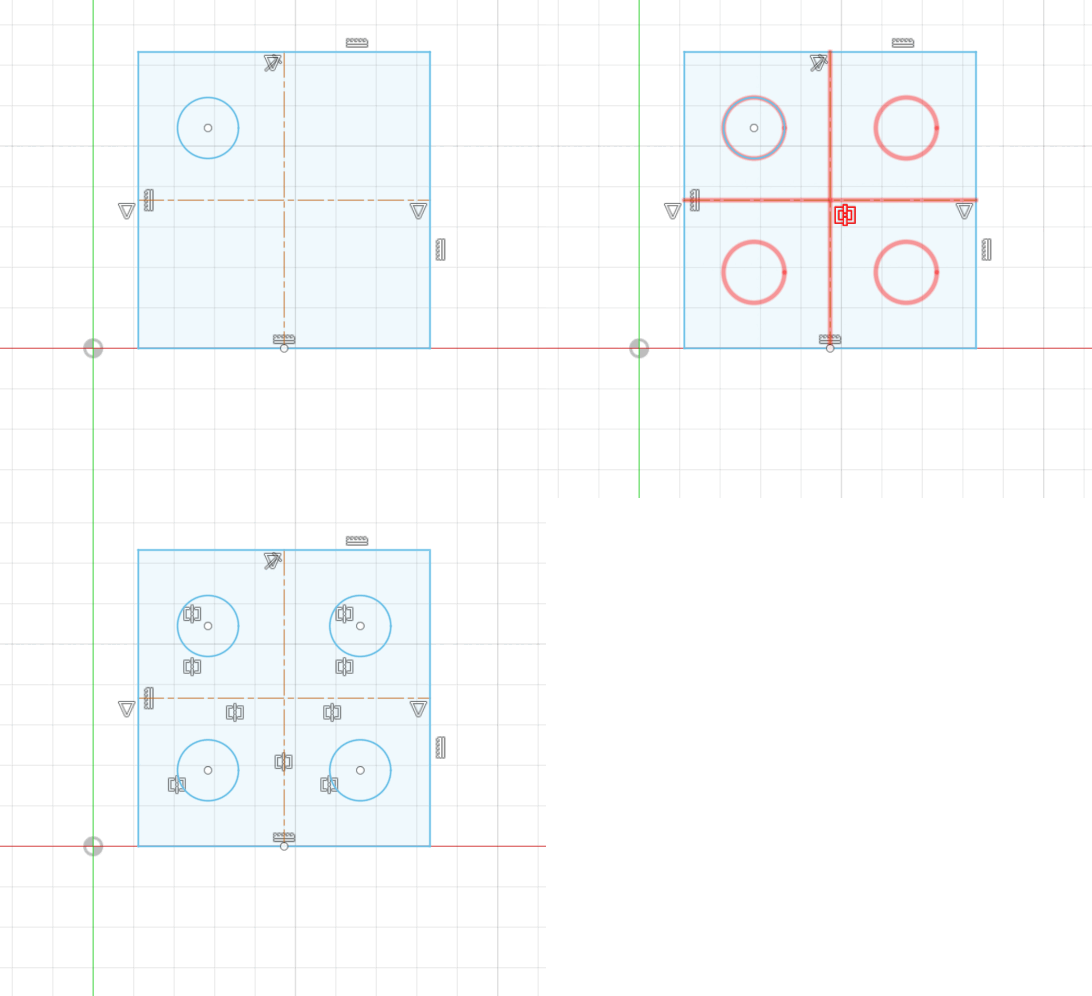
In testing a model of a standard brick, the AI’s capability for "quad-mirroring" was particularly impressive. Where a human might spend several minutes defining axes and applying symmetrical constraints to four corners, Hestus identified the pattern and offered the complete constraint set instantly.
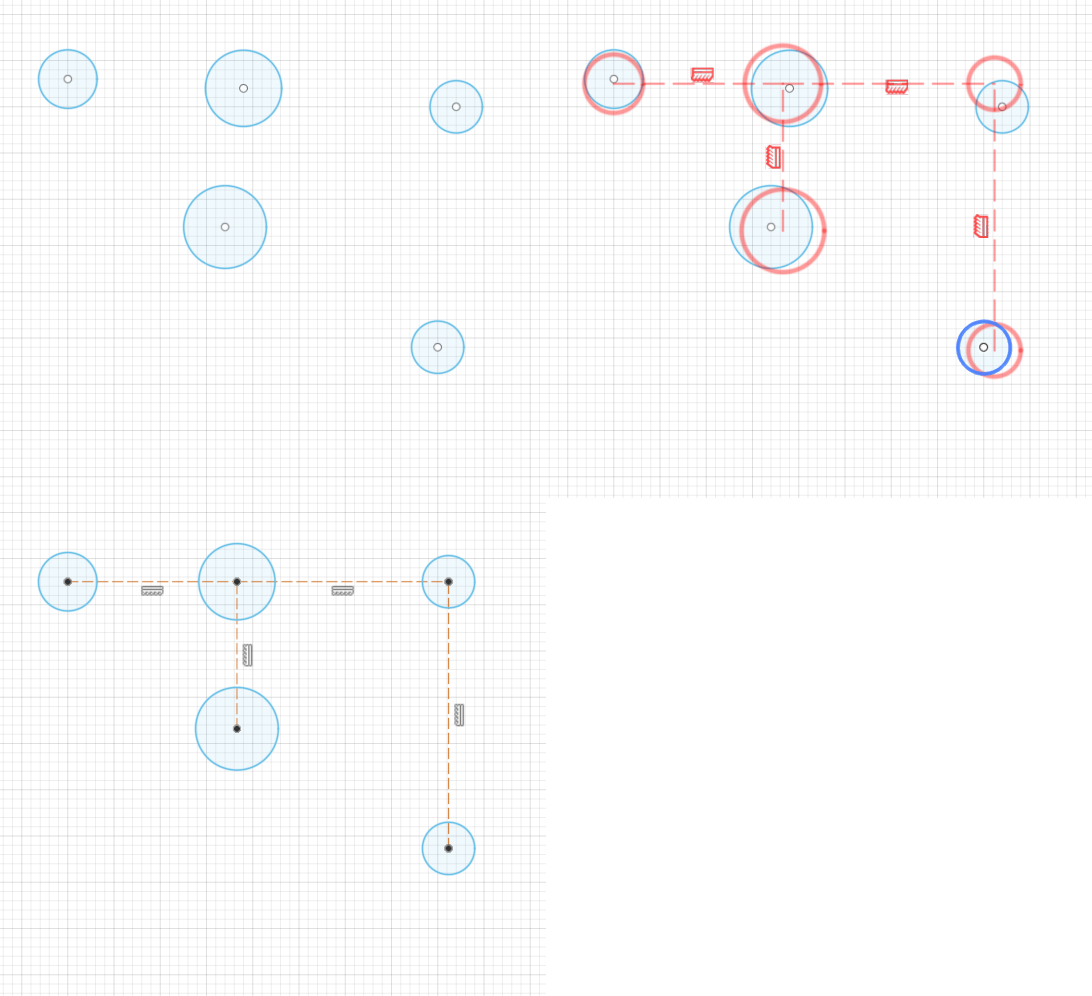
However, the tool is not yet a panacea. When tasked with designing a clock face, which requires complex radial symmetry, the software struggled. Currently, Hestus excels at Cartesian and mirror-based relationships but is still developing its understanding of circular patterns. It is an honest limitation; the team is transparent about their roadmap, noting that radial symmetry is already under development.
The Technological Architecture: Why LLMs Aren’t Enough
A critical distinction in the Hestus development process is their rejection of Large Language Models (LLMs) for geometric tasks.
"An LLM can never truly understand physical geometry," Haghighat notes. Because LLMs are probabilistic engines designed for text and tokens, they are fundamentally ill-equipped to handle the strict, logical requirements of CAD software. Instead, the Hestus team trained a custom, proprietary model from the ground up, specifically optimized for the structural language of geometric constraints.
This distinction allows Hestus to act with a degree of precision that standard AI chatbots cannot achieve. While today’s iteration of Hestus offers predictions roughly 10–30 seconds into the future of a workflow, the long-term vision is far more ambitious. The company is working toward a model that can support 3D features—such as extrusions, fillets, and chamfers—and offer multi-step recommendations that package a new geometry, a set of constraints, and dimensioning into a single interaction.

Implications: The Future of Manufacturing Intelligence
The implications of this technology extend far beyond mere speed. As Hestus matures, the vision moves toward "Design Intent Awareness."
Imagine a future where your CAD software acts as a junior manufacturing engineer. As you sketch, Hestus could provide live warnings:
- Manufacturing Feasibility: "The wall thickness here is too thin for standard injection molding."
- Design for Assembly: "The diameter of this hole is incompatible with common M3 fasteners."
- Structural Integrity: "The geometry of this support beam is prone to stress concentrations."
By moving from a reactive tool to a proactive consultant, Hestus aims to catch errors before they even reach the prototyping phase. This would drastically reduce the "design-test-fail-repeat" cycle that plagues mechanical engineering, potentially saving companies thousands of dollars in wasted materials and manufacturing time.
Supporting Data and User Efficiency
According to internal benchmarks provided by the Hestus team, the plugin can increase sketching efficiency by an average of 2.5x. This figure is highly dependent on the nature of the project—the more symmetrical and rule-bound the design, the higher the performance gain.

For the average engineer, this translates to:
- Reduced Cognitive Load: By offloading the "bookkeeping" of constraints, engineers can keep their focus on the "why" rather than the "how" of a model.
- Standardization: Using an AI assistant ensures that models are constrained consistently, making them easier for team members to edit or update later.
- Faster Prototyping: The ability to move from a rough idea to a fully constrained sketch in record time allows for more rapid iteration cycles.
A Measured Approach to Innovation
The most refreshing aspect of Hestus is its "opt-in" culture. In an era where many software developers are racing to integrate AI into everything, often at the cost of user control, Hestus feels grounded. It does not force the user into a workflow; it simply nudges them toward a more efficient path.
As the tool continues to evolve, the multiplier on productivity is expected to climb. The roadmap includes more advanced constraint types like midpoints and collinearity, as well as the aforementioned expansion into 3D feature recognition.
For engineers who have spent years manually clicking through constraint menus, Hestus represents a long-overdue evolution in CAD software. It is a tool that respects the craft of engineering while acknowledging that even the most creative minds can benefit from a little help with the mundane.
Hestus is currently available as a free download for users looking to accelerate their design process. As the community continues to grow, the integration of these predictive tools into the standard CAD suite may soon move from a "nice-to-have" plugin to an industry-standard requirement for any engineer looking to stay competitive in an increasingly fast-paced manufacturing landscape.
To discuss this article or share your experiences with the Hestus plugin, join the conversation on the Makezine Discord server.
Author

Related Posts
Toshiba Unveils High-Performance Multiplexers to Power Next-Generation PCIe 6.0 and USB4 v2 Architectures
- 0
- 1,135 word
In the rapidly evolving landscape of high-speed data interconnects, the bottleneck often lies not in the processor or the memory, but in...
Read out all
MRAM Reaches a Strategic Tipping Point: New Industry Alliance Formed to Scale Adoption
- 0
- 1,114 word
Magnetoresistive Random Access Memory (MRAM)—a technology once relegated to the fringe of semiconductor research—has officially hit a commercial and technical tipping point....
Read out all
DEEPX Unveils the DX-AIPlayer: Bridging the Gap Between Edge Computing and High-Performance AI
- 0
- 1,258 word
In the rapidly evolving landscape of edge artificial intelligence, the demand for hardware that balances power efficiency with high-throughput inference has never...
Read out all
The Smart Shopper’s Pulse: Tracking the Best Daily Deals in an Era of Digital Hype
- 0
- 1,214 word
By Daniel Oropeza | Shopping Editor May 13, 2026 In the modern digital marketplace, the consumer is bombarded with a relentless stream...
Read out all
Bridging the Digital Divide: How Experience AI is Empowering Classrooms in Uzbekistan
- 0
- 1,266 word
In an era defined by the rapid proliferation of artificial intelligence, the global race to ensure digital equity has moved beyond basic...
Read out all
The Mirror in the Machine: Unmasking Algorithmic Bias in the Age of AI
- 0
- 1,266 word
The widespread adoption of artificial intelligence (AI) has been accompanied by a persistent, often unexamined, myth: that algorithms are objective, mathematically neutral...
Read out all